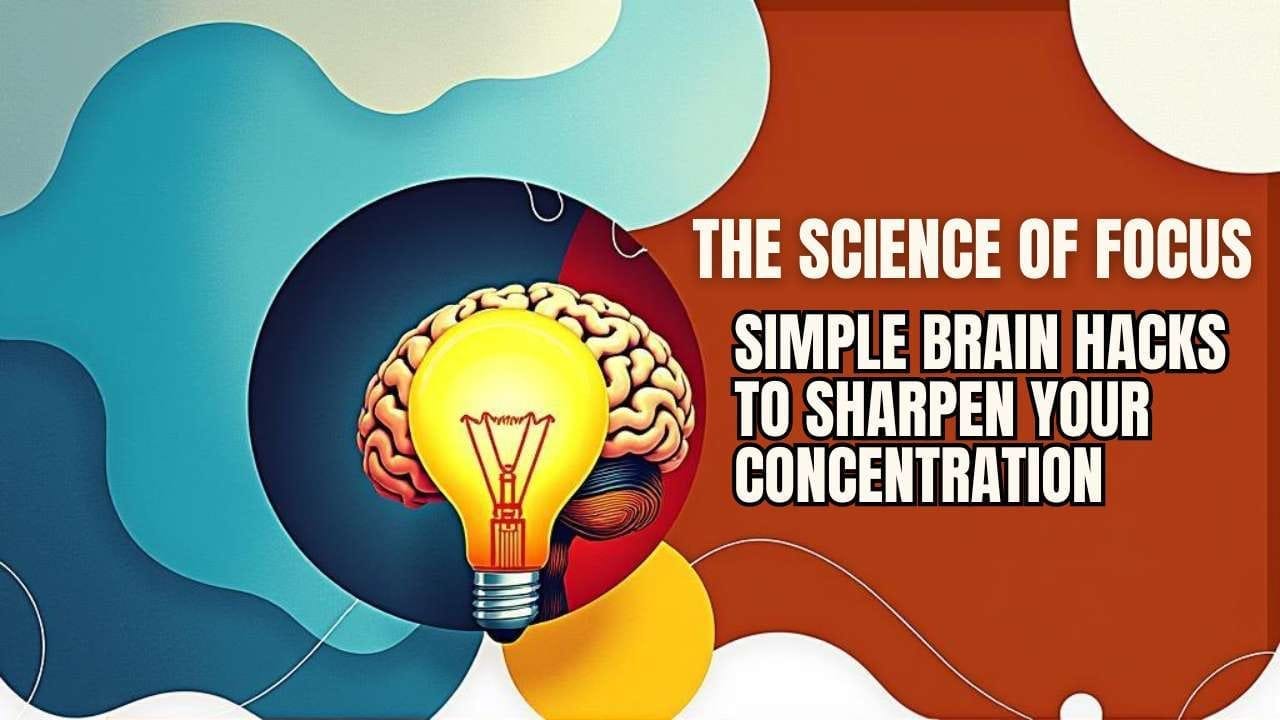
The Science of Focus: Simple Brain Hacks to Sharpen Your Concentration
The Science of Focus: Train Your Brain to Concentrate
Have you ever sat down at your desk, opened your laptop, and promised yourself, “Today I will finish this task,” only to find that 20 minutes later you are scrolling through social media, checking messages, or lost in random thoughts? If yes, you are not alone. In fact, almost everyone in today’s fast-moving digital world struggles with the same challenge — staying focused.
Focus has become the new superpower. It is not about working harder or longer. It is about channeling your energy in one direction, like a laser beam. Imagine your mind as a torchlight. When it is scattered, it only produces dim light. But when you concentrate it, the same torchlight becomes a laser that can cut through steel. That’s the power of focus.
Science proves that your brain is not fixed. You can actually train your brain to focus better, just like you train your body at the gym. This is where things get exciting. The latest neuroscience research shows that with small, daily practices, you can rewire your brain to ignore distractions, reduce stress, and enter a state of deep concentration.
In this blog, I am going to walk you through both the science and the practical techniques to master focus. You will discover how your brain works when you concentrate, what blocks your focus, and step-by-step methods to build a sharp, unshakable attention span.
By the end, you won’t just understand focus — you will be ready to train it like a muscle and use it as a secret weapon to achieve success faster than ever.
Why Focus Matters in Today’s Distracted World
Let’s be honest. We live in the most distracted era of human history. Notifications pop up every minute, emails never stop, and the temptation of scrolling “just for 5 minutes” easily turns into one hour. Our attention is being hijacked every single day — not by accident, but by design. Tech companies spend billions of dollars to capture your focus, because your attention is their profit.
Now pause for a moment and think: if the world is fighting to control your attention, shouldn’t you be the one who learns to protect it?
Here’s the truth — your ability to focus is directly linked to your success, happiness, and growth. Whether you are a student preparing for exams, a professional aiming for promotion, or an entrepreneur building your dream business, focus decides how far you go.
Science confirms this. Research from Stanford University shows that people who multitask regularly have reduced memory, lower productivity, and weaker focus compared to those who train themselves to concentrate on one thing at a time. Multitasking is a myth — your brain doesn’t actually do two things at once. It just switches rapidly between tasks, wasting precious mental energy in the process.
Think of your focus as a bank account. Every time you allow distractions, you are leaking money. But when you direct your focus with discipline, you are making investments that grow with time. That’s why high performers — athletes, CEOs, artists — protect their focus like a treasure. They know it’s their ultimate advantage.
So, the question is not “Do you want to focus?” The real question is “Can you afford to live without focus in today’s world?”
The answer is clear. If you don’t take charge of your mind, someone else will. And if you master focus, you automatically create a powerful edge that sets you apart from 99% of people.
The Neuroscience of Focus — How Your Brain Handles Attention
Have you ever wondered why it feels so hard to concentrate sometimes? The answer lies inside your brain. When you understand how your brain handles attention, you’ll know exactly how to train it.
Let’s start with a simple fact: focus is not a gift, it’s a skill powered by your brain’s wiring. And the most important player here is your prefrontal cortex — the CEO of your brain. It sits right behind your forehead and is responsible for decision-making, self-control, and attention.
When your prefrontal cortex is active, you can block out distractions and zoom in on what matters. But here’s the catch — it has limited energy. Think of it like your phone battery. If you overload it with too many apps (multitasking, endless scrolling, constant checking), the battery drains fast. That’s why after a few hours of scattered work, you feel mentally exhausted.
Now, there’s another system in your brain that influences focus: the reticular activating system (RAS). This is like your brain’s filter. Imagine you’re in a crowded room, yet when someone says your name, you instantly notice it.
That’s your RAS at work. It decides what information gets your attention and what gets ignored. Here’s the key: you can program your RAS by setting clear goals. When you tell your brain, “This is important,” it starts filtering distractions automatically.
Science also shows us the role of brain waves. When you’re deeply focused, your brain shifts into alpha and theta states, which are calm but alert.
That’s why techniques like meditation and breathing exercises sharpen your concentration — they literally tune your brain waves into focus mode.
But there’s a challenge. Every ping, every pop-up, every notification hijacks your brain’s reward system. Dopamine — the “feel-good” chemical — gets released when you check your phone.
This makes distractions addictive. In fact, neuroscientists say your brain reacts to a phone buzz just like it reacts to sugar or gambling. It craves the hit.
So, if you’ve been struggling with focus, it’s not because you’re weak. It’s because your brain has been wired by constant stimulation. The good news? Neuroplasticity — your brain’s ability to rewire itself — allows you to build stronger focus circuits with the right practice.
Here’s the takeaway: focus is like a muscle. The more you train it, the stronger it gets. And the moment you learn how your brain operates, you stop blaming yourself and start working with your brain, not against it.
Common Enemies of Focus (and How They Steal Your Attention)
If you’re serious about mastering focus, you must first recognize your enemies. Because the truth is — distractions don’t just happen randomly. They are designed. And unless you identify them, they will keep stealing your energy, time, and dreams.
1. Digital Distractions
The biggest thief of your focus today is your smartphone. Social media platforms, apps, and notifications are not harmless. They are built by some of the smartest scientists and psychologists in the world to keep you hooked.
Each “like” or message releases dopamine, making you crave more. This constant interruption trains your brain to expect quick rewards instead of deep work.
Here’s the problem: every time you switch tasks — from work to Instagram, from study to WhatsApp — your brain takes time to refocus. Scientists call this attention residue.
It means even after you return to your work, part of your brain is still stuck in the last task. That’s why multitasking feels busy but leaves you drained and unproductive.
2. Mental Clutter
Sometimes, the distraction isn’t outside — it’s inside your head. Overthinking, worrying about the past, or planning too far into the future fills your mental space. Imagine your brain as a desk.
If it’s covered with papers, files, and junk, there’s no space to actually work. Mental clutter works the same way. It blocks clarity and reduces concentration.
3. Environment Traps
Your surroundings shape your attention more than you realize. A noisy place, messy workspace, or even the people around you can constantly pull you away from focus.
Research shows that even seeing your phone on the desk — without touching it — reduces mental performance. That’s how powerful your environment is.
4. Lack of Rest & Energy
Focus requires fuel. When you’re sleep-deprived, dehydrated, or running on junk food, your brain simply can’t function at its peak. Lack of sleep affects your prefrontal cortex, the part that controls attention and decision-making.
That’s why you find yourself easily distracted when you’re tired — your brain literally doesn’t have the strength to resist.
5. Unclear Goals
Here’s a hidden enemy: not knowing what to focus on. If you start your day without a clear target, your brain wanders. It looks for stimulation wherever it can find it — emails, chats, random scrolling. Clarity is power.
Without it, your brain becomes vulnerable to every little distraction that comes along.
Here’s the bottom line: Distractions are not just bad habits, they are carefully designed traps. But once you see the traps, you can escape them.
Your phone doesn’t control you. Your mind clutter doesn’t define you. And your environment doesn’t have to hold you back. The moment you learn to master these enemies, you create space for your focus to shine.
How To Train Your Brain to Concentrate: Science-Backed Methods
Now that you know the enemies of focus, it’s time to train your brain like a warrior. Focus is not luck. It’s a skill. And like any skill, it can be practiced, improved, and mastered.
Let me share with you five powerful, science-backed methods that can transform the way you concentrate.
1. Single-Tasking Over Multitasking
We live in a world that glorifies multitasking. People boast about replying to emails while attending meetings, or scrolling Instagram while “studying.”
But here’s the truth: multitasking is a lie.
Research from Stanford University shows that multitaskers are actually worse at paying attention, remembering information, and switching between tasks.
Why?
Because the brain is not designed to handle two complex tasks at the same time.
When you multitask, you are not doing two things together. You are rapidly switching between them. Each switch leaves behind “attention residue.” It’s like leaving breadcrumbs of your mind everywhere. No wonder you feel tired but unproductive.
Solution: Embrace single-tasking. Choose one important task, set a timer, and give it your full attention. When you train yourself to go deep instead of wide, you will get more done in less time.
2. The Pomodoro Technique
One of the simplest yet most powerful tools for focus is the Pomodoro Technique. Developed by Francesco Cirillo in the 1980s, it’s based on working in focused intervals.
Here’s how it works:
Set a timer for 25 minutes.
Work on one task with zero distractions.
When the timer rings, take a 5-minute break.
Repeat. After 4 rounds, take a longer break of 15–20 minutes.
This method works because it gives your brain a clear structure. You train yourself to enter “deep work mode” in small chunks. And the short breaks prevent mental fatigue.
Personally, I love this technique because it creates urgency. You know you have only 25 minutes, so your brain resists procrastination and dives straight into the work.
3. Mindfulness Meditation
Do you know what meditation really is? It’s not about sitting cross-legged for hours. It’s about training your attention.
Studies from Harvard and MIT show that mindfulness meditation increases the density of gray matter in the brain regions responsible for learning, memory, and focus.
In simple words, meditation rewires your brain to pay attention better.
You don’t need to meditate for hours. Even 10 minutes a day can create a big difference. Sit quietly, close your eyes, and focus on your breath. Every time your mind wanders, gently bring it back. That’s one repetition.
Just like lifting weights builds muscles, each return builds your focus muscle.
4. Visualization
Have you noticed how athletes prepare before a big game? They don’t just train physically — they also train mentally. They visualize themselves winning, scoring, and performing at their best.
Visualization is a powerful tool for focus. When you imagine yourself completing a task with full concentration, your brain fires the same neurons as if you’re actually doing it. This primes your mind for success.
Here’s a quick exercise: Before starting your work, close your eyes for one minute. Visualize yourself working with deep focus, finishing the task, and feeling proud. This creates mental momentum before you even start.
5. Anchoring Peak Focus State (NLP Technique)
This is one of my favorite NLP strategies. Anchoring means creating a trigger that instantly connects you to your best state of mind.
Think about a time when you were completely focused, in flow, unstoppable. Can you remember it? Good. Now, here’s how to anchor it:
Recall that peak focus state vividly — see what you saw, hear what you heard, feel what you felt.
Intensify the feeling in your body.
At the peak of this state, create a unique physical gesture — like pressing your thumb and index finger together.
Repeat this process a few times until the association is strong.
Now, whenever you need focus, use this anchor. It’s like a mental switch to activate your best energy on demand.
The Bottom Line
Your brain is like a muscle. If you train it with science-backed techniques, it becomes sharper, stronger, and faster. Single-tasking eliminates energy leaks. Pomodoro builds discipline. Meditation strengthens attention. Visualization primes you for success. And NLP anchoring gives you instant access to focus whenever you need it.
Master these methods, and you’ll notice something amazing — focus will no longer feel like a struggle. It will become your natural way of working, living, and winning.
Daily Habits That Strengthen Focus
My friend, if you truly want to master focus, you don’t just need techniques—you need daily habits that shape your brain like a laser.
Science is clear: what you repeatedly do wires your brain. And the good news? Even small, consistent habits can reprogram your attention system.
Let’s dive into the daily rituals that will transform your ability to concentrate.
Morning Ritual to Prime Your Brain
How you start your day decides how your brain behaves the entire day. If the first thing you do is scroll social media, your brain gets addicted to distraction. Instead, prime your brain with clarity rituals.
The best performers in the world—CEOs, athletes, scientists—follow this:
Start your day with intention.
Sit quietly for 5 minutes. Set one intention for the day. For example: “Today, I choose focus over distraction.”
Read or listen to something uplifting. This feeds your subconscious with empowering input.
Avoid the phone for the first hour. Train your brain to run on your agenda, not the world’s chaos.
When you win the morning, you win the day.
Journaling to Clear Mental Clutter
Your brain is not a storage device—it’s a processing machine. When you overload it with random thoughts, unfinished tasks, and worries, focus becomes impossible.
Journaling is like a mental detox. Just 5 minutes of writing can clear space for deep concentration.
Here’s a simple format:
Write down 3 things you’re grateful for.
Write your top 3 priorities for the day.
Write one sentence about how you want to show up today (e.g., “I will bring focus and energy.”)
This small act declutters your mental desktop and gives your brain a sharp direction.
Nutrition + Hydration for Mental Clarity
Your brain is 2% of your body weight, but consumes 20% of your energy. If you eat junk, your focus becomes junk.
Eat brain foods: nuts, seeds, green vegetables, blueberries, and whole grains.
Stay hydrated: even 2% dehydration reduces focus dramatically. Keep a water bottle nearby and sip through the day.
Avoid sugar crashes: replace sugary snacks with protein-rich options.
Remember, clarity in mind begins with clarity in diet.
Movement/Exercise for a Sharper Mind
When your body moves, your brain grooves. Exercise increases blood flow, oxygen, and neurochemicals like dopamine and serotonin that fuel focus.
Just 20 minutes of brisk walking boosts concentration for hours.
Stretching or yoga in between work sessions refreshes mental energy.
Strength training builds not just muscles, but also mental resilience.
Think of exercise as your brain’s charging cable.
Digital Hygiene: Protecting Your Focus Zone
Let’s be honest—most people don’t lack focus, they lose it to notifications. Every ping is a theft of your attention. If you want to protect your focus like a treasure, you need digital hygiene.
Turn off all non-essential notifications.
Use focus apps (like Forest or Freedom) to block distractions during work.
Create no-phone zones—bedroom, dining table, or first hour of the morning.
When you control your devices, you control your focus.
👉 Start with one habit today. Tomorrow, add another. Slowly, you’ll notice your mind becoming sharper, calmer, and unstoppable. Because habits don’t just build focus—they build you.
Practical 5-Minute Exercises to Improve Focus
Let me share a secret—focus is like a muscle. The more you train it, the stronger it becomes. You don’t need hours of practice. Just 5 minutes a day with the right exercises can rewire your brain for sharper attention.
Here are four simple yet powerful techniques you can start using today.
1. Candle Flame Meditation
Sit in a quiet place, light a candle, and gently focus your eyes on the flame.
Don’t stare harshly, just observe softly. As thoughts come, let them pass and return your attention to the flame.
This trains your brain to return to one point—the very definition of focus. Just 5 minutes daily will increase your concentration power like magic.
2. 5-4-3-2-1 Sensory Grounding
Whenever your mind wanders, bring it back with this quick grounding method:
Notice 5 things you can see.
Notice 4 things you can touch.
Notice 3 things you can hear.
Notice 2 things you can smell.
Notice 1 thing you can taste.
This simple exercise pulls you out of distractions and anchors you in the present moment.
3. Box Breathing for Calm Concentration
This is a favorite of Navy SEALs for staying calm under pressure.
Inhale for 4 counts.
Hold for 4 counts.
Exhale for 4 counts.
Hold for 4 counts.
Repeat for 4–5 rounds. Within minutes, your nervous system relaxes, your brain clears, and your focus sharpens.
4. Quick NLP Submodality Shift
Your brain represents distractions as images, sounds, or feelings. You can rewire them.
Imagine your distraction as a bright, loud image.
Now shrink it, make it blurry, push it far away.
Next, imagine your task as a sharp, colorful, close-up picture.
Your brain will automatically feel pulled toward the task and away from the distraction.
👉 Pick one of these exercises and practice today. In just 5 minutes, you’ll feel the shift. Because when you train your focus, you unlock your true power.
How to Create a Focus-Friendly Environment
My friend, here’s a truth you cannot ignore—your environment shapes your focus more than your willpower. Even the sharpest brain will lose energy if it is surrounded by chaos, noise, or constant distractions.
So, let’s design a focus-friendly environment that supports your brain instead of fighting against it.
Decluttering Your Workspace
A cluttered desk creates a cluttered mind. When your eyes see piles of papers, open tabs, and scattered items, your brain leaks energy. Take 5 minutes each day to tidy up. Keep only the tools you need for the current task on your desk. A clean workspace tells your brain, “This is the zone for deep work.”
Light, Sound, and Temperature Hacks
Science shows that natural light boosts alertness and mood. If possible, sit near a window or use a daylight lamp. For sound, avoid loud, chaotic noise. Use noise-canceling headphones or calming background sounds. And don’t underestimate temperature—research suggests 22–25°C (72–77°F) is ideal for focus. Too hot or too cold, and your brain wastes energy adjusting.
Using Music or Binaural Beats
Music is a powerful tool—if you use it wisely. Classical music, soft instrumental, or binaural beats at alpha frequency (8–12 Hz) can shift your brain into a relaxed yet highly focused state. Avoid songs with lyrics when doing deep work, as they compete for your attention. Instead, let sound guide your brain into flow.
Accountability Partner or “Focus Buddy”
Sometimes, the best environment is not just physical—it’s social. Find a “focus buddy”—a friend, colleague, or coach who works alongside you, either in person or virtually.
When you know someone is holding you accountable, your mind resists distractions. You stay on track because you don’t want to break the commitment.
👉 Remember this: You don’t need more willpower; you need a smarter environment. When your space, sound, light, and support system are designed for focus, you’ll enter deep work effortlessly.
Conclusion: Your Focus is Your Future
We’ve covered a lot in this guide—from understanding why focus is so powerful, to learning science-backed techniques, daily habits, and quick exercises that sharpen your attention.
You now know how to design your environment, protect your energy, and even shape your identity into that of a Focused Achiever.
But let me remind you of one thing: your dreams depend on your ability to focus. No matter how big your goals are, they will remain out of reach if your attention is scattered.
At the same time, even the biggest mountains can be climbed if you give consistent, focused effort.
Don’t wait for the “perfect day” or the “right mood” to start. Begin small. Today itself, choose one simple practice. Maybe it’s 10 minutes of single-tasking. Maybe it’s a 5-minute candle meditation. Maybe it’s writing down your top three tasks and finishing one without distraction. That little step is how focus muscles grow.
Remember, success is not about doing more—it’s about doing what truly matters with your undivided attention.
👉 Now it’s your turn. I want to hear from you: Comment below with one distraction you’ll eliminate today.
Whether it’s turning off notifications, closing extra tabs, or saying no to endless scrolling—declare it.
Make your commitment real.
Your focus is your future. Guard it. Train it. And watch your life transform.
With Gratitude & Growth,
Coach Rakesh Inani ✨
NLP & Mind Performance Coach | Growth Mindset Expert
Founder of RI NLP Academy 🌿
Helping You Build Focus, Confidence & Unstoppable Momentum

RI NLP Academy is a premier learning hub founded by Coach Rakesh Inani, dedicated to empowering individuals with advanced NLP techniques, mindset mastery tools, and life-transforming strategies. Our mission is to help people reprogram their minds, unlock their true potential, and create lasting success in every area of life.






Newsletter
Subscribe now to get daily updates.
Copyright @ RI NLP ACADEMY 2025